Yucatán property taxes for foreigners work exactly as they do for Mexican nationals: predial is a municipal tax assessed on cadastral value, running roughly 0.05–0.35% of that value, about MXN 1,500–6,000 a year for a mid-range Mérida home. The complications sit elsewhere: the ISAI acquisition tax at closing, the ownership structure required inside Mexico’s restricted zone, the municipal tax on rental income, and the taxes triggered when you sell. At Balam Group we work with buyers in Mérida and across the Yucatán Peninsula, and we stay with owners through the whole cycle: purchase, ownership, rental, sale. This guide follows that cycle.
Key Takeaways
- Mérida and the Yucatán coast both sit inside Mexico’s 50 km restricted zone, so foreign buyers take title through a bank trust (fideicomiso) or a Mexican corporation rather than direct escritura.
- Closing costs run roughly 6–9% of value, with ISAI at generally 2.5% in the city of Mérida (progressive on higher-value homes), 3% in Progreso, Chelem and Chuburná, and up to 4% in Telchac Puerto.
- On the annual side, predial is low, about 0.05–0.35% of cadastral value, and the primary-residence ISR exemption on sale is open to temporary or permanent resident visa holders up to roughly MXN 3.8 million.
How Much Are Annual Property Taxes (Predial) for Foreigners in Yucatán?
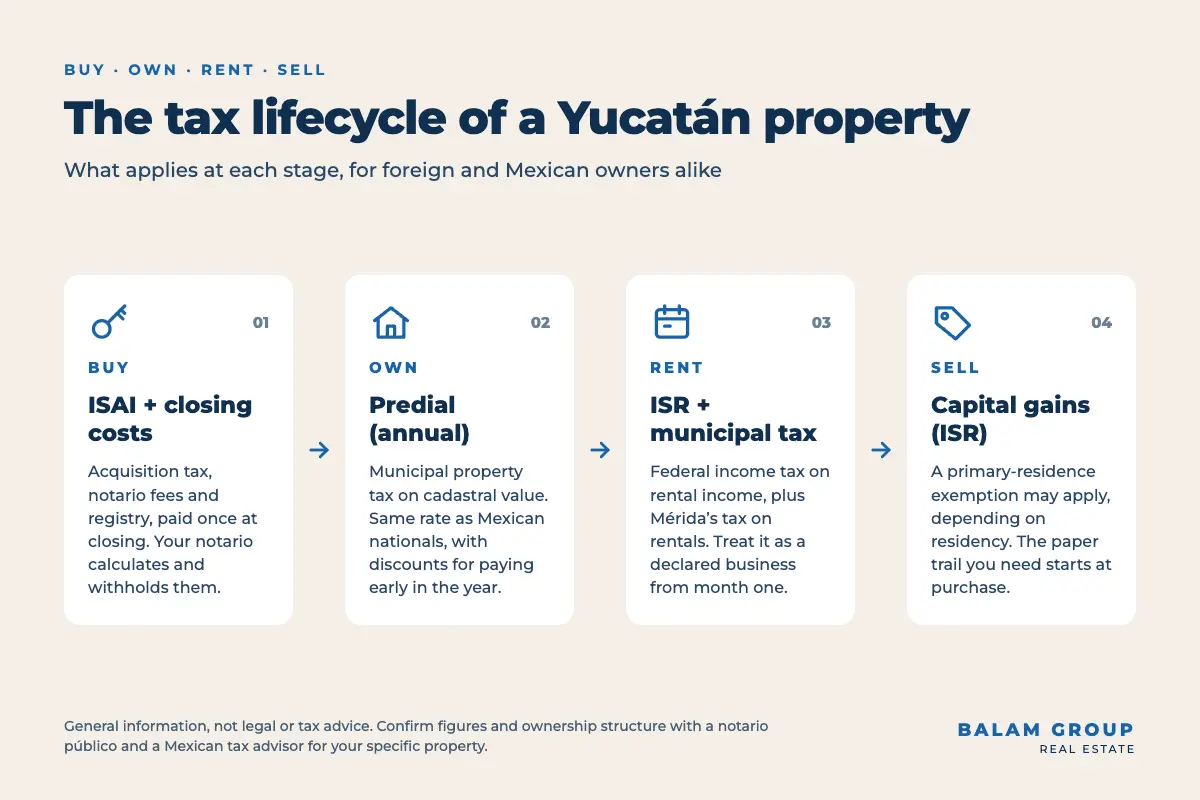
Foreign owners pay the same predial as Mexican nationals: roughly 0.05–0.35% of cadastral value statewide, and approximately 0.13–0.35% in the municipality of Mérida, about MXN 1,500–6,000 a year for a mid-range Mérida home (Ley de Hacienda del Municipio de Mérida; TheLatinvestor). There is no nationality surcharge of any kind.
Predial is assessed on cadastral value, the figure the municipality carries on its own rolls, not on what you paid. Buy above cadastral value and you still pay on the cadastral number until the municipality updates its assessment.
What it costs in practice:
- Mid-range Mérida home: MXN 1,500–6,000 per year
- High-value homes: MXN 25,000 or more per year
Yucatán municipalities also reward early payment on a tiered schedule. Paying at the tesorería in January earns a discount of up to 20%, February typically 10–15%, and March roughly 8–10%. Most owners get a real reduction just by putting the payment in the calendar for the first weeks of the year.
One practical note: predial receipts matter later. Keep every year’s stamped receipt. They form part of the paper trail a notario público reviews when you sell.
What Taxes and Fees Do Foreign Buyers Pay When Purchasing Yucatán Real Estate?
Budget roughly 6–9% of property value for total closing costs where a fideicomiso is used (TheLatinvestor). Here is what sits inside that number.
ISAI (Impuesto Sobre Adquisición de Inmuebles)
In the city of Mérida, ISAI is generally 2.5%, with some reporting describing a progressive scale reaching 4–4.5% on higher-value homes (Ley de Hacienda del Municipio de Mérida; Plalla; Prime Property Yucatán). On the coast, expect 3% in Progreso, Chelem and Chuburná, and up to 4% in Telchac Puerto.
Gain Tax on Real Estate Acquisition
Where the value determined by the tax authority exceeds the agreed purchase price, a 20% tax applies to the difference. Notarios flag this variance routinely during due diligence, and it is the reason a declared price below market value rarely produces the saving buyers expect.
Notario Fees
Roughly 2–3% of appraised value (Plalla; TheLatinvestor). The notario público is a state-appointed lawyer who drafts the escritura, calculates and withholds taxes, and registers title.
Registry and Certificates
Registration with the state public property registry, plus the lien certificate, no-debt certificates and the appraisal. Your notario itemizes these before signing.
Fideicomiso and SRE Permit
Trust setup runs about USD 1,500–2,500, with an annual administration fee of USD 500–800. The required permit from the Secretaría de Relaciones Exteriores costs approximately MXN 21,650 (≈ USD 1,200).
IVA
Residential purchases carry no 16% IVA. Commercial property does, and buyers usually acquire it through a Mexican corporation so the IVA can be credited.
Fideicomiso vs. Mexican Corporation: Which Legal Structure Works Better for Foreign Buyers’ Tax Strategy?
Both Mérida and the Yucatán coast fall inside the 50 km restricted zone, so foreign buyers choose between two structures. Most residential buyers use the fideicomiso. A Mexican corporation suits a narrower but real profile.
Fideicomiso (bank trust)
- Predial: identical to nationals.
- At sale: the primary-residence ISR exemption is available to temporary or permanent resident visa holders, capped at roughly MXN 3.8 million. The Yucatán state cedular tax of about 5% applies to corporation owners and non-residents, so a resident seller may fall outside it, a point to confirm with a Mexican tax advisor.
- Cost: the USD 500–800 annual administration fee runs for as long as you hold the property.
- If you rent: federal ISR applies, plus the Mérida municipal use/occupation tax on rental income (0.03 per month for housing, 0.05 for other uses).
Mexican corporation
- Best fit: multi-property investors focused on rental operations, who accept cedular tax exposure of about 5% on sale in exchange for operating flexibility across several units.
- No personal primary-residence exemption. A company does not have a residence, so the ISR exemption is unavailable.
- Ongoing obligations: monthly filings and a Mexican accountant on retainer.
- Also standard for commercial property, where the 16% IVA needs to be credited.
What actually decides it: your residency timeline, whether the property is residential or commercial, whether you plan to rent it, and your exit horizon. Those four answers usually settle the structure before anyone discusses rates. Because the outcome is parcel-specific, we line up the notario and the legal referrals so the structure question gets answered in writing, on the facts of your property, before an offer is signed.
Myth vs. Reality: What Foreigners Get Wrong About Yucatán Property Taxes
Three misconceptions account for most closing-table surprises.
Myth: foreigners pay a premium predial rate.
Reality: rates are identical to those Mexican nationals pay. The only foreign-specific costs are trust setup, the SRE permit, and the annual trust fee, and that last one recurs every year rather than sitting once in your closing statement.
Myth: a Mexican corporation makes taxes disappear.
Reality: the state cedular tax of about 5% applies to corporation owners on sale, corporate accounting is continuous, and the personal primary-residence ISR exemption is unavailable. AMPI-affiliated agents and notarios públicos consistently advise choosing the structure around the intended use of the property rather than around a hoped-for tax saving.
Myth: vacation rental income is not taxed at the municipal level.
Reality: Mérida applies a municipal use/occupation tax on rental income, 0.03 per month for housing and 0.05 for other uses, on top of federal ISR. Short-term platforms increasingly report earnings to Mexican authorities, so undeclared rental activity is visible.
Two further realities worth naming: rates and municipal rules change, so treat every figure here as of the cited sources; and the correct structure depends on the specific parcel, not on a national rule of thumb.
Yucatán Yields and Smart-Home Integration: How Low Carrying Costs Amplify Investment Returns
Low predial improves net yield for one unglamorous reason. Money not spent on annual tax stays in the return.
The arithmetic is simple. A mid-range Mérida home carrying MXN 1,500–6,000 per year has a holding cost that barely registers against rental income. On a high-value coastal property at MXN 25,000 or more, it stays a modest line item. Over a five- to ten-year hold, that gap compounds into equity rather than into a municipal treasury.
Documentation is where the money is actually won or lost. The ISR exemption and any deduction at sale depend on paperwork: utility bills in your name at that address, predial receipts, invoices for capital improvements, and occupancy records if you rent.
That is why we build smart systems into the homes we represent. Automated energy monitoring, digital access logs and rental dashboards produce dated, exportable records, which may support both Mexican tax compliance and capital-gains exemption documentation. For owners holding several units, the same records turn municipal and federal filings into a data export. Technology does not reduce your tax. It reduces the chance you lose an exemption you were entitled to.
FAQ
Do I need a fideicomiso to buy property in Mérida?
In Mérida, yes — a fideicomiso or a Mexican corporation, because the city sits inside Mexico’s 50 km restricted zone. The same applies on the coast at Progreso, Chelem, Chuburná and Telchac Puerto. Trust setup runs about USD 1,500–2,500, with a USD 500–800 annual fee and an SRE permit of approximately MXN 21,650 (≈ USD 1,200).
When and how do I pay predial in Yucatán?
Annually, at your municipality’s tesorería. Paying in January earns a discount of up to 20%, February 10–15%, and March 8–10%. Most non-resident owners authorize a property manager or legal representative to pay locally and forward the stamped receipt, which belongs in your documentation file for sale.
What if the authority’s determined value differs from my purchase price?
Where the value determined by the tax authority exceeds the agreed price, a 20% Gain Tax on Real Estate Acquisition applies to the difference. Notarios catch this during due diligence, before signing, so treat it as a variable rather than a fixed line in your closing budget.
Can I avoid capital gains tax when I sell?
Partially, under conditions. The primary-residence ISR exemption is available to temporary or permanent resident visa holders and is capped at roughly MXN 3.8 million. The Yucatán cedular tax of about 5% applies separately to corporation owners and non-residents. Residency status and address documentation take time to build, so this planning starts at purchase, not at listing.
What taxes apply if I rent my property out?
Rental income is subject to federal ISR, and in Mérida to a municipal use/occupation tax of 0.03 per month for housing (0.05 for other uses). Platforms increasingly report earnings to Mexican authorities, so treat rental activity as a declared business with a Mexican accountant from month one.
Final Thoughts
Yucatán’s tax profile is attractive and unspectacular: low predial, no IVA on residential purchases, and an achievable exemption path for resident sellers. What varies is structure, and structure is parcel-specific. At Balam Group we work with buyers in Mérida and across the Yucatán Peninsula, and I am glad to walk through the numbers for a particular property or neighborhood and introduce you to a notario público who can review the parcel in writing.
This article is general information, not legal or tax advice. Confirm all figures and structure decisions with a licensed notario público and a Mexican tax advisor for your specific parcel.
About the Author
Gregory Hokenson founded Balam Group Real Estate. He has lived and worked in Merida for nearly two decades and has overseen more than 50 residential projects across the Yucatan. He is a member of AMPI and the National Association of Realtors.