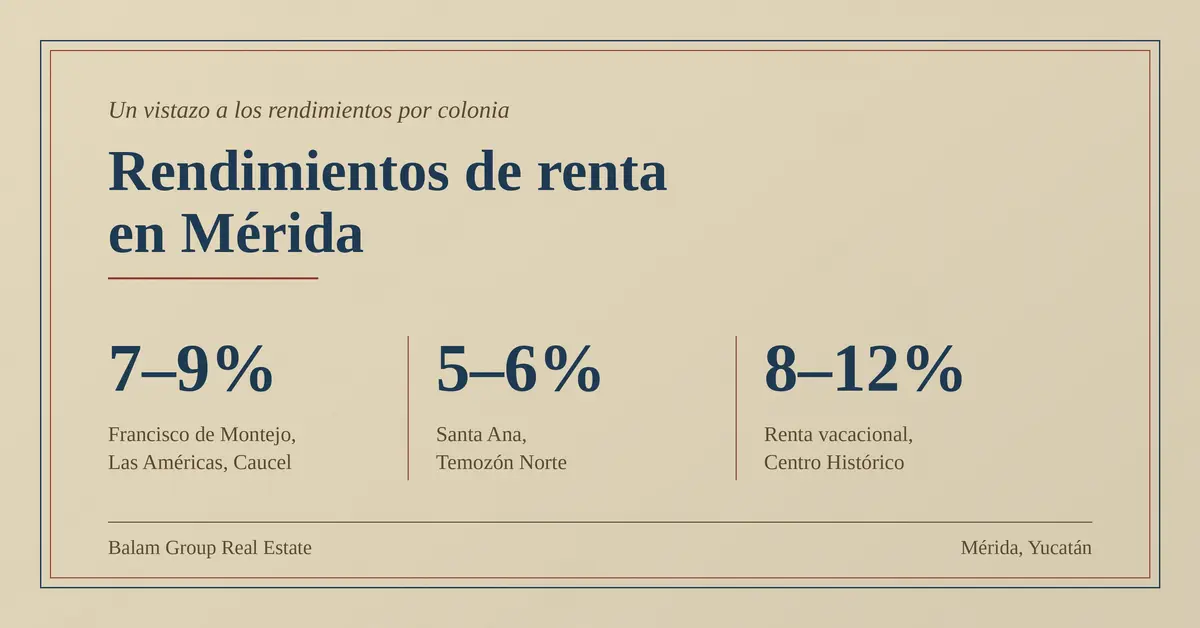
Across Mérida rental yield neighborhoods, long-term rentals typically return 5–8% gross and around 5% net after costs. Mid-market family colonias — Francisco de Montejo, Las Américas, Ciudad Caucel — sit at the top of the table at roughly 7–9% gross, while premium zones such as Santa Ana and Temozón Norte run nearer 5–6% gross. GlobalPropertyGuide records a Mérida average of 6.64% gross citywide across all property types. Property type moves the number as much as location does.
All figures are in Mexican pesos unless stated otherwise. This article is general information, not legal or tax advice.
Key Takeaways
- Mid-market family colonias out-earn premium addresses on percentage return: Francisco de Montejo, Las Américas and Ciudad Caucel model at roughly 7–9% gross, against 5–6% in Santa Ana and Temozón Norte (aggregated Mérida investor guides).
- Unit size matters more than prestige: 2BR apartments average 7.48% gross citywide, while 4+BR properties average 5.18% (GlobalPropertyGuide, Mérida section).
- Short-term rentals trade predictability for upside: Centro Histórico gross yields of 8–12% lose roughly two to four points once platform fees, management, cleaning and cooling are paid (our modeling assumption).
What Is a Normal Rental Yield Range Across Mérida Rental Yield Neighborhoods, and How Do Gross and Net Yields Differ?
A normal Mérida long-term rental produces 5–8% gross and about 5% net, and the gap between those two numbers is where most out-of-country underwriting goes wrong.
Gross yield is annual rent divided by purchase price. Net yield subtracts the operating lines:
- Management: typically 8–10% of collected rent on long-term leases.
- Predial: Mérida’s municipal property tax, low relative to coastal markets.
- HOA and maintenance: the hot-climate items — minisplit servicing, roof waterproofing, pool chemicals.
- ISR: Mexican income tax on rental earnings, filed through registration with SAT. Confirm your filing obligations with a Mexican accountant.
The first thing I check on a Francisco de Montejo listing is the age of the minisplits and whether the roof has an intact sealed coat. On properties I have managed, those two items have moved net yield by close to a full point — my own operating observation, not a market statistic.
The worked examples in the next section use monthly rents of MXN 12,000–16,000 against purchase prices of MXN 1.9–2.6M. Those are our modeling assumptions for a standard mid-market unit, not published averages.
On title: foreign buyers should confirm with a notario whether the specific parcel sits inside Mexico’s restricted zone. Where it does, a fideicomiso bank trust is a common structure and carries setup and annual fees that belong in your net-yield model. Confirm that with your notario before you finalize any projection.
Which Mérida Rental Yield Neighborhoods Offer the Highest Returns by Property Type?
Mid-market family colonias lead on net yield for standard two- and three-bedroom rentals, with Centro Histórico competitive on renovated small apartments.
| Colonia | Type | Price | Monthly rent | Gross | Net | Basis |
|---|---|---|---|---|---|---|
| Francisco de Montejo | 2BR house | 2.4M | 14,500 | 7.3% | ~5.5% | Worked example |
| Las Américas | 2BR house | 2.3M | 14,000 | 7.3% | ~5.5% | Worked example |
| Ciudad Caucel | 2BR house | 1.9M | 12,000 | 7.6% | ~5.7% | Worked example |
| Chuburná de Hidalgo | 2BR house | 2.6M | 15,000 | 6.9% | ~5.2% | Worked example |
| Centro Histórico | Renovated 1BR | 2.4M | 16,000 | 8.0% | ~5.4% | Worked example |
| Centro Histórico | Colonial house | 7.5M | 37,500 | 6.0% | ~4.2% | Worked example |
| Santa Ana / Temozón Norte | Premium homes and condos | — | — | 5–6% | ~3.5–4.5% | Investor guides |
| Montebello, Montes de Amé, Itzimná, García Ginerés | Stable mid-to-upper | — | — | 6–7% | ~4.5–5% | Investor guides |
Worked examples are our own price-and-rent models; the net column deducts roughly 1.7–2.6 percentage points for management, predial, maintenance and tax, weighted higher on furnished and older stock. Your inputs will differ.
By property type, GlobalPropertyGuide’s Mérida apartment data shows 1BR at 6.83%, 2BR at 7.48%, 3BR at 7.08% and 4+BR at 5.18% gross. Larger houses rent for more in absolute pesos but rarely in proportion to what they cost to buy, insure and cool.
Tenant depth is a separate metric from headline yield. Montebello, Montes de Amé, García Ginerés, Itzimná and Francisco de Montejo are consistently named for reliable occupancy. In my own leasing, San Ramón Norte and Vía Montejo draw furnished expat long-term tenants, and Mejorada picks up Centro-style demand at lower entry prices, while Dzityá, La Ceiba and parts of Temozón Norte behave more like appreciation plays than income assets.
How Do Long-Term Rentals and Short-Term Vacation Rentals Compare for Yield in Mérida?
Long-term leases deliver steadier net returns near 5% with light management; short-term rentals can reach 8–12% gross in Centro Histórico but land several points lower once you pay for the operation.
Reported short-term benchmarks for Mérida cluster around:
- Occupancy: roughly 58% on an annual average.
- ADR: about MXN 840 per night.
- Annual revenue per listing: approximately MXN 179,000.
Against that revenue you carry platform fees, cleaning, higher power draw and management we assume at about 20% for full nightly service. On our modeling, that pulls an 8–12% gross Centro Histórico unit toward the mid-to-high single digits net — still above a long-term lease, but earned with far more operating work and season risk.
Check the regulations yourself rather than assuming them. Short-term rental requirements vary by municipality and condominium regime, and a state lodging tax applies to short stays; confirm current rules, rates and any registration duties before you underwrite.
Tenant profile by strategy:
- Tourists and expat short stays: Centro Histórico, Santa Ana, Santiago, Mejorada, the Paseo de Montejo corridor.
- Local professionals and families on 12-month leases: Francisco de Montejo, Las Américas, Ciudad Caucel, Chuburná de Hidalgo.
- Furnished expat long-term: García Ginerés, Montebello, Itzimná, San Ramón Norte, Vía Montejo — a middle path that earns a rent premium without nightly turnover.
The Smart-Home Advantage: How Property Features Shift Your Yield Potential
Automated climate control, keyless entry and energy monitoring push a unit toward the top of its colonia’s rent range and shorten vacancy gaps. None of the published yield studies model this. Worth knowing anyway.
Three things matter in a climate where cooling is a permanent line item:
- Cost control: scheduled and sensor-driven cooling cuts the largest variable expense in a Yucatán rental, and lower expenses raise net yield without raising rent.
- Remote oversight: systems such as Orvibo let an owner abroad check occupancy, utilities and access without a site visit, trimming the practical need for full-service management.
- Guest and tenant experience: for short-term listings, reliable cooling and self check-in support the reviews that keep occupancy above break-even.
For furnished long-term units in García Ginerés or Montebello, I have seen automated, well-insulated homes lease faster and at the upper end of their colonia’s rent range. That is an observation from my own leases, not a market statistic — treat it as a hypothesis to test in your own underwriting. Balam Group specifies these systems in the listings we handle, for that reason.
Myth vs. Reality: What Actually Drives Rental Yield in Mérida
Purchase price, not rent level, decides yield. High-rent colonias frequently return the lowest percentages because acquisition costs ran ahead of the rental market.
- Myth: Centro Histórico colonials always yield best. Restoration and upkeep pull a colonial house toward 6.0% gross and 4.2% net in our model, while a renovated small apartment in the same district models near 8.0% gross and 5.4% net.
- Myth: premium northern addresses guarantee returns. Santa Ana and Temozón Norte sit closer to 5–6% gross despite strong absolute rents.
- Myth: more bedrooms, more yield. 4+BR properties average 5.18% against 7.48% for 2BR apartments citywide (GlobalPropertyGuide).
Named Downsides You Should Price In
- Short-term revenue is seasonal. Winter months carry the year; a soft late spring and summer can undo an optimistic annual average.
- Hot-climate maintenance is permanent. In our experience, AC servicing, waterproofing and humidity damage account for much of the gross-to-net drop; budget them as recurring, not one-off.
- Yield compression is already visible in the premium north, where prices have moved faster than achievable rents.
FAQ
What minimum yield should I target in Mérida?
A reasonable screen is 7% or better gross and roughly 5% net on a long-term lease. Francisco de Montejo, Las Américas, Ciudad Caucel and renovated small units in Centro Histórico clear that in our models, while premium northern and Santa Ana stock generally falls short on percentage return.
Do apartments or single-family homes yield more?
Apartments, on average. GlobalPropertyGuide’s Mérida figures show 7.48% gross for 2BR apartments against 5.18% for 4+BR properties. Houses in mid-market family colonias still compete well when bought at the right price, because their tenant pool of local professionals is deep and turnover is low.
How do management fees and taxes affect net yield?
Long-term management runs about 8–10% of rent; nightly operations absorb platform fees plus roughly 20% management (our assumption), cleaning and higher power use. Add predial, ISR through SAT and any applicable lodging tax on short stays. Those lines are why a 5–8% gross range lands near 5% net.
Which neighborhoods have the most stable tenant demand?
Investor guides repeatedly name Montebello, Montes de Amé, García Ginerés, Itzimná, Chuburná de Hidalgo and Francisco de Montejo for reliable occupancy. Stability and headline yield are different metrics: a colonia can hold near-continuous tenancy while returning a percentage in the mid-fours because entry prices are high.
Is now a reasonable time to buy a rental in Mérida?
Yields are holding in the 5–8% gross band, so entry conditions are workable rather than exceptional. The case is stronger in mid-market colonias with accessible pricing than in premium zones where net returns have compressed. Confirm current tax and short-term rental rules before committing to a strategy.
Sources
- GlobalPropertyGuide, gross rental yields in Mexico, Mérida section (citywide average and yields by bedroom count).
- Aggregated published Mérida investor guides and market summaries, used for range-level figures only.
- Worked price-and-rent examples and net-yield deductions are the author’s own modeling assumptions, clearly labeled as such.
Final Thoughts
Mérida pays off for buyers who match property type, colonia and tenant profile, then underwrite the maintenance and tax lines honestly. Two-bedroom homes and apartments in mid-market family colonias carry the strongest net returns; premium addresses carry the weakest. If you want to walk these neighborhoods and compare models on the ground, Balam Group Real Estate will do that with you, in person.
About the Author
Gregory Hokenson founded Balam Group Real Estate. He has lived and worked in Merida for nearly two decades and has overseen more than 50 residential projects across the Yucatan