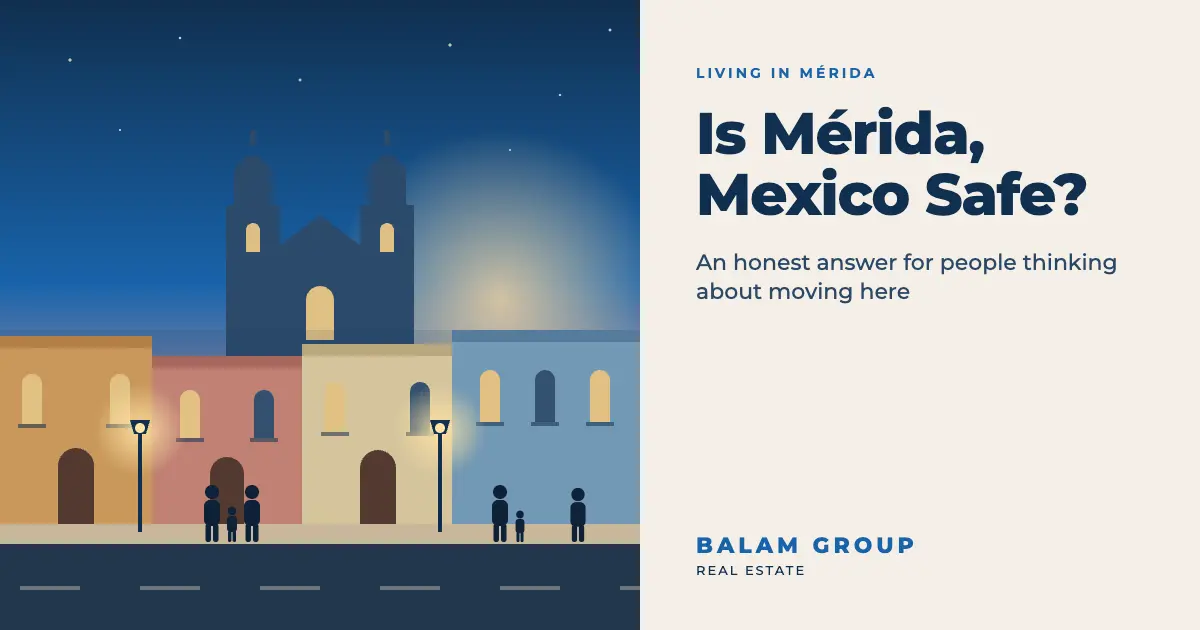
People ask me whether Mérida, Mexico is safe more often than they ask anything else. The short answer: yes, by every official measure I can point to, Mérida is among the safest major cities in Mexico, and Yucatán has held that position for years. The longer answer is more useful. Safety for someone moving here is not the same as safety for someone visiting for five days. It comes down to the colonia you pick, the heat, the paperwork, and who holds the title to your house.
Key Takeaways
- Yucatán was ranked the most peaceful state in Mexico for the ninth consecutive year in the Mexico Peace Index 2026 (Institute for Economics and Peace), with a state homicide rate of 1.8 per 100,000 in 2025 against a national 18.1.
- The U.S. State Department Mexico Travel Advisory issued in August 2025 places the State of Yucatán at Level 1, “Exercise Normal Precautions,” the lowest of four levels, while Quintana Roo (Cancún, Playa del Carmen, Tulum) sits at Level 2.
- For anyone relocating rather than visiting, long-term safety depends as much on choosing a reputable developer and verifying property documentation (the notario’s title work, the escritura, the tax liabilities) as it does on crime statistics.
How Does Mérida’s Safety Actually Compare to the Rest of Mexico?
Mérida is an outlier in Mexico, and the gap is wide, not marginal.
The hard numbers, as reported in the Mexico Peace Index 2026:
- Yucatán state homicide rate: 1.8 per 100,000 in 2025, against a national rate of 18.1 — roughly a tenfold difference.
- Mérida municipality: among the five lowest municipal homicide rates in the country, with 16 cases, or 1.61 per 100,000, in 2025.
- Nine consecutive years as the most peaceful state in Mexico.
Perception runs on a separate track, and that is where I see the most confusion. INEGI’s ENSU urban safety survey recorded Mérida’s perception of insecurity at 39.2% in March 2025, 41.9% in June 2025, and 36.9% in December 2025 — still far below the national 63.8% in the December 2025 wave. Violent crime did not spike during that window. What moved was national mood plus locally reported petty and property crime. Perception followed the property crime, not the violence.
Compared with tourist-driven cities, the difference is basic. Yucatán holds Level 1 in the August 2025 U.S. State Department advisory; Quintana Roo, home to Cancún and Playa del Carmen, carries Level 2. Mérida is a residential and administrative capital, not a nightlife economy, and the crime profile reflects that.
Is Mérida Safe for Expats and Foreigners Living Here Full-Time?
Yes, and it is the daily experience that convinces most people, not the index rankings. Travel guides tell you to watch your bag on Calle 60. Living here raises different questions.
- Walking at night: In the Centro Histórico, along Paseo de Montejo, and in Santa Ana, Santiago, and García Ginerés, families are out on the plazas late into the evening. Well-lit, well-trafficked streets stay comfortable. Empty side streets at 2 a.m. deserve the same caution you would use in any city.
- Driving: The risk here is traffic behavior, not crime. Motorcycles pass on both sides, the one-way grid in Centro is unforgiving, and pedestrian right-of-way is treated loosely.
- Household help: Many households employ cleaners, gardeners, or caretakers. Hire through people who know the person, and have a contador or labor attorney set the arrangement up properly, including IMSS registration where it applies. Trust networks are how this city actually works.
For buyers, safety and neighborhood reputation end up tied together in the price. A colonia with active street life, functioning lighting, and long-term residents holds value better than an isolated subdivision that photographs well.
I worked with a couple from Portland who were set on a large lot on the far northern edge because the asking price looked better. We walked it with them at 9 p.m. There was no lighting, no neighbors, and no taxi coverage. They bought in García Ginerés instead and kept walkability. Nearly two decades here has taught me that the evening walk tells you more than the listing sheet.
What Are the Safest Neighborhoods in Mérida, and How Do You Evaluate Them?
Mérida’s lowest-risk residential areas are consistent, and you can check any of them yourself in a single day.
Colonias people relocating here most often shortlist:
- Centro Histórico: colonial houses, pasta tile floors, high ceilings, walkable to markets and plazas. Dense and active, which helps.
- Paseo de Montejo, Santa Ana and Santiago: the mansion corridor and its adjacent barrios, heavily patrolled and heavily walked.
- García Ginerés: mid-century homes, mature trees, neighborhood parks, established families.
- Newer north-side developments: recent construction, gated access, closer to hospitals and malls, more car-dependent.
Four things I tell clients to do on any block they like:
- Walk it three times: midday, 8 p.m., and Sunday morning. Different city each time.
- Count working street lights on the block and the two adjacent blocks.
- Check services within walking distance: pharmacy, tienda, clinic, bus route.
- Look for community presence: people on porches, kids on bikes, businesses that have clearly been there years.
Construction and developer choices matter beyond crime data. Perimeter walls, controlled access, quality window and door hardware, and smart-home systems for cameras, lighting, and leak detection all change how a house behaves when you are not in it.
Legal safety is the part people underestimate. A notario público is a state-appointed official who verifies title and executes the deed, and the notario — not an agent, and not this article — issues the written determination that governs your specific parcel.
- In the city of Mérida, foreign buyers are commonly deeded property directly in their own name by escritura.
- For coastal property inside Mexico’s restricted zone (Progreso, Chicxulub, Telchac, Sisal), one commonly used option is a fideicomiso, a bank trust held for the buyer’s benefit; other ownership structures exist, and your notario will confirm which applies. Setup and annual trust costs vary — ask the notario and the trustee bank for a written quote before you commit.
- Budget for ISAI, the state property acquisition tax, and ask the notario for an itemized closing estimate.
What Crime Should You Actually Worry About in Mérida?
The crime most likely to touch you here is property crime, not violence.
> Myth: Mérida is crime-free.
> Reality: Petty and opportunistic theft exist, and per INEGI’s ENSU trend through December 2025 they contributed to rising insecurity perception even while violent crime stayed flat.
What actually happens:
- Pickpocketing and bag-snatching in crowded settings: Mercado Lucas de Gálvez, bus terminals, festival crowds on Paseo de Montejo.
- Opportunistic vehicle break-ins when laptops, bags, or tools are visible.
- Unoccupied-home entries, most often at properties that sit empty for months with no caretaker or monitored system.
- Newcomer-targeted scams: inflated “gringo pricing,” unlicensed contractors taking large deposits, informal rental deals with no written contract, and pressure to skip the notario.
Habits that matter more when you live here than when you visit:
- Do not leave anything visible in a parked car, ever.
- Use a caretaker or monitored alarm if the house will be empty seasonally.
- Pay contractors in staged payments tied to completed work, never a large lump sum up front.
- Verify professionals. A cédula profesional for an architect or engineer, and AMPI membership for an agent, are checkable.
- Keep late-night walking to lit, populated streets and use known transport otherwise.
How Does Mérida’s Climate and Infrastructure Fit Into Your Safety Plan?
The risks most likely to affect your first year here are environmental, not criminal.
Heat is the dominant one. Spring afternoons climb well into the 30s C, and that is a genuine health consideration for older residents and anyone working outdoors. Some people never fully adapt to eight hot months, which is one reason I suggest renting through a full spring before buying. Dengue is present as well, so screens and standing-water control matter.
Hurricane season runs through the summer and autumn. Mérida’s inland position blunts direct storm impact compared with the coast, but heavy rain, street flooding, and multi-day power interruptions do happen. That makes infrastructure quality a resale question as much as a comfort one. Much of Centro Histórico sits on older drainage that backs up in sustained rain, while newer north-side developments were built with more recent stormwater and electrical infrastructure. Ask about the specific street’s flooding history and the construction era of the house. Both show up later in insurance conversations and in what a buyer will pay.
Construction quality is the part you can control. Insulation and roof treatment reduce air-conditioning load, which is the single largest driver of a CFE bill here. Storm shutters, generator or battery backup, and leak sensors on cisterns and water lines cut both risk and repair cost.
FAQ
Is Mérida safer than Cancún or Playa del Carmen?
Yes, on the available official measures: Yucatán holds a Level 1 U.S. State Department advisory (August 2025) while Quintana Roo, which includes Cancún and Playa del Carmen, is Level 2. Mérida is a residential capital rather than a high-volume tourism economy, and its crime profile reflects that.
Is Mérida safe at night?
Generally yes in well-trafficked areas such as Paseo de Montejo, the Centro Histórico, Santa Ana, and Santiago, where families are out late into the evening. Standard urban precautions still apply: lit streets, known transportation, and more caution in outlying colonias.
Is Mérida safe for solo women or families?
Plenty of solo women and families with children relocate here, and the conditions that make it comfortable apply to both: dense walkable barrios, active plazas, low violent-crime rates. The practical advice is the same as anywhere else. Favor lit, populated streets at night, use known transport rather than street hails, and treat crowded markets and festival crowds as pickpocket environments.
Is Mérida safe from hurricanes and flooding?
Mérida’s inland location shields it from the direct coastal storm surge that affects Progreso and the Gulf beach towns, but it still sees heavy rain, localized street flooding, and power outages during storm season. Ask about the flooding history of the specific street and about drainage, backup power, and roof condition before you buy.
What does the U.S. State Department say about Yucatán?
The advisory issued in August 2025 assigns the State of Yucatán Level 1, “Exercise Normal Precautions,” the lowest of four levels. Yucatán is among the small group of Mexican states at Level 1; check the current advisory before you travel, as ratings are periodically revised.
How bad is crime in Mérida compared with the rest of Mexico?
It is among the lowest in the country: the Mexico Peace Index 2026 records 16 homicides in Mérida in 2025, a rate of 1.61 per 100,000, placing the municipality among Mexico’s five lowest. Petty theft, vehicle break-ins, and newcomer-targeted scams are the realistic concerns for residents.
Sources
- Mexico Peace Index 2026, Institute for Economics and Peace — state and municipal peace and homicide tables (visionofhumanity.org/resources).
- Mexico Travel Advisory, U.S. Department of State, issued August 2025 — state-by-state advisory levels (travel.state.gov, Mexico Travel Advisory page).
- ENSU (Encuesta Nacional de Seguridad Pública Urbana), INEGI — March 2025, June 2025, and December 2025 waves, percentage of adults perceiving their city as unsafe, Mérida urban area and national aggregate (inegi.org.mx/programas/ensu).
Figures here reflect data published through the December 2025 ENSU wave and the August 2025 advisory. Both sources are updated on a schedule, so check the source pages for later releases before relying on a number.
Final Thoughts
Mérida’s safety record is measurable, and it is not a marketing claim. For someone moving here, safety comes down to three decisions: the colonia you choose, the daily habits you keep, and the documentation you insist on before signing. Yucatán’s stability gives you the foundation. The rest is due diligence, done in person, on the street, at three different hours of the day.
If you want to talk through colonias, construction standards, and title questions for your own situation, that is the conversation we have every week at Balam Group.
About the Author
Gregory Hokenson founded Balam Group Real Estate. He has lived and worked in Merida for nearly two decades and has overseen more than 50 residential projects across the Yucatan.