16 nov 2026 · @Gregory Hokenson
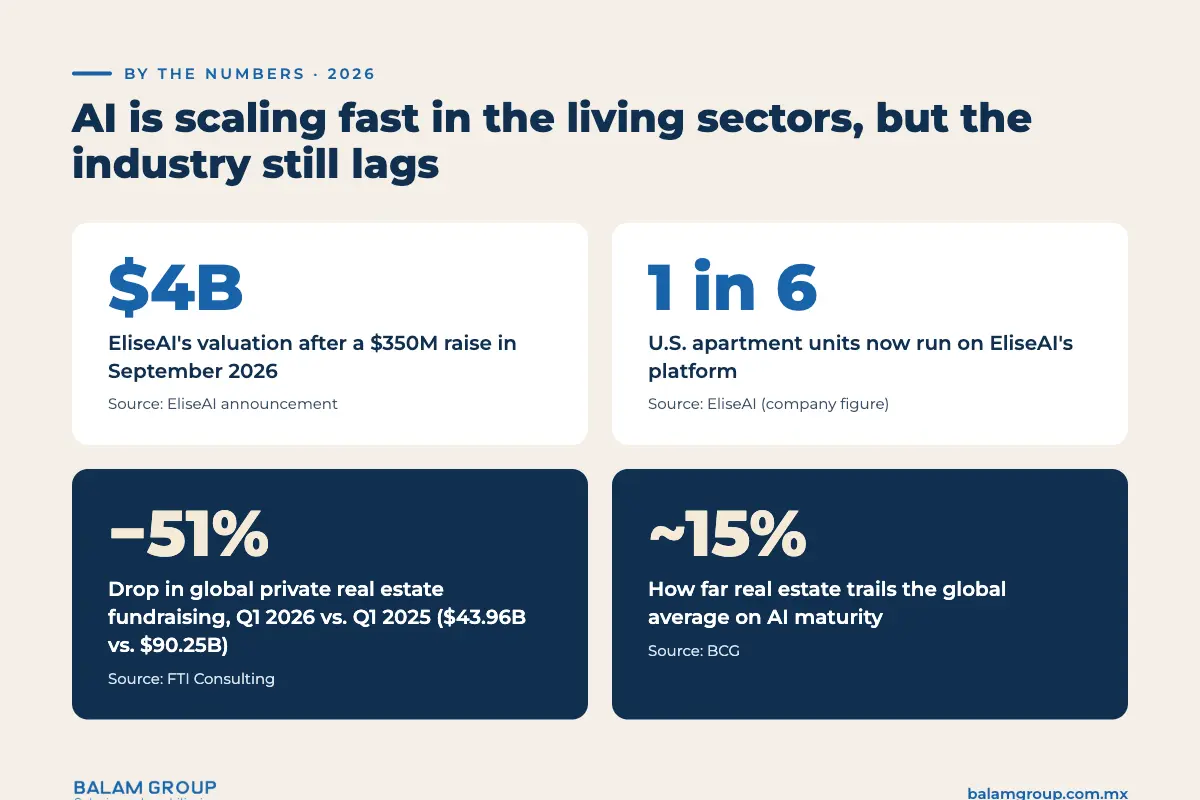
In September 2026, EliseAI raised $350 million at a $4 billion valuation, and one of its lead investors noted that an AI plan is now a requirement in every pitch to owners. That single detail captures the real story of AI in alternative real estate: the biggest change isn’t happening in listings or chatbots for renters. It’s happening business-to-business, in how platforms sell to operators, how operators underwrite deals, and how sponsors raise capital.
Why the living sectors are AI’s testing ground
Student housing, build-to-rent, senior living and co-living have become the investor favorites of this cycle, and they are also where AI is landing first. At Europe GRI 2026, senior decision-makers named the living sector among the themes drawing capital, while noting AI is already cutting operating costs and sharpening valuations (GRI Institute). Pictet Alternative Advisors’ head of real estate put the logic simply: AI may threaten some property types, but people still need somewhere to sleep (CoStar).
The fit is operational. Living assets run on thousands of small, repetitive interactions: inquiries, tours, renewals, maintenance tickets, rent collection. That is exactly the work AI agents handle well. It also answers a staffing problem, since onsite housing teams can see turnover above 40% a year (EliseAI / Business Wire).
The operating platform becomes the product
EliseAI is the clearest example of how fast this B2B market has scaled. The company crossed $200 million in annual recurring revenue in June 2026 after five straight years of doubling, and says it now powers one in six U.S. apartment units (AI Magazine / GlobeNewswire). Its customers include more than 600 owners and operators, among them Brookfield, AvalonBay, Equity Residential and Invitation Homes (Bisnow).
The growth pattern matters more than the headline. Operators first bought it for leasing and resident messaging, then asked it to take on maintenance, billing and renewals (Commercial Observer). In September 2026 it launched Apollo, an agent meant to work across a property team’s whole software stack (Unite.AI). The business model is classic enterprise SaaS: priced per unit per month and sold through a demo-driven sales team (Sacra).
The same shift shows up across niches. Walker & Dunlop reports student housing operators using AI leasing tools to track pricing, manage lease-up and time concessions (Walker & Dunlop). Yardi expects 2026 to be the year AI moves from experiment to operating standard across build-to-rent, single-family rental and co-living (Yardi). Competition is heating up too: incumbents like Yardi and AppFolio can bundle cheaper automation into software operators already pay for (Simplify).
Underwriting at the speed of a prompt
On the investment side, AI is shortening the path from thesis to deal. Development teams now use AI workflows to screen build-to-rent sites and compress the underwriting cycle (Build). In student housing, the hard parts are niche-specific: enrollment trends, per-bed revenue, pre-leasing velocity and parent-guarantor credit, all tied to an academic calendar rather than a 12-month lease.
Consultants serving this market claim AI cuts student housing analysis time by 40% to 60% and guarantor credit review from days to hours (The AI Consulting Network). Those are vendor numbers, not audited results. Still, the direction is clear: the analyst who once built one pro forma a week can now pressure-test several, and buyers expect sellers of software and services to speak that language.
Capital formation: AI scales the outreach, people still close
Raising money has rarely been harder, which is why AI is moving into investor relations. Private real estate raised $43.96 billion globally in Q1 2026, down from $90.25 billion a year earlier (FTI Consulting). Capital is also concentrating: the 10 largest funds took more than half of all private equity capital raised that quarter (AppFolio, citing PitchBook).
Sponsors are responding with AI that targets LPs using relationship data, finds warm introduction paths and personalizes outreach at scale (InvestorFlow). Industry workshops now teach GPs to build AI agents that research investors, draft outreach and produce thought-leadership content (Bisnow).
The catch is that everyone gets the same tools. AppFolio argues that when every GP has the same AI underwriting and data, the deal becomes table stakes and service becomes the edge (AppFolio). Fundraisers at SuperReturn made the same point: technology changes how they work, not the importance of the relationships the process depends on (Informa Connect).
The adoption gap is the opportunity
For all the momentum, real estate is behind. BCG finds the industry lags the global average on AI maturity by about 15%, with only about a quarter of real estate companies seeing real impact (BCG). Deloitte’s 2026 outlook survey found 19% of firms still describe their AI adoption as early or experimental (Agora, citing Deloitte).
That gap is where B2B growth lives. Most operators and sponsors know they need an AI plan. Far fewer know which tools fit their portfolio, how to integrate them, or how to measure the return. The companies that close that gap for them, and the people who can explain it in plain business terms, are positioned to win.
What this means for the people who sell these platforms
As AI becomes standard, selling into alternative real estate is shifting from pitching features to proving operating results. Buyers are better informed, sales cycles run through demos and pilots, and the winning conversation is about NOI, staffing models and investor reporting rather than software. The sellers who stand out will be the ones who can:
- Speak operator. Understand lease-up, occupancy, turnover and per-unit economics well enough to tie a product to a line on the P&L.
- Qualify with discipline. Use frameworks like BANT to find accounts with real budget, a clear decision-maker, a defined pain and a timeline, instead of chasing every demo request.
- Sell the outcome, not the AI. Frame value as faster lease-up, fewer onsite hours or quicker capital raises.
- Earn trust over time. In a market where tools are converging, credibility and follow-through become the differentiator.
I’ve spent 18 years in real estate in Mérida, Mexico, qualifying leads, building sales teams and working with developers and investors. The lesson from this research matches what I see on the ground: AI multiplies a good sales process, it doesn’t replace one. The platforms that pair strong technology with sellers who understand real estate will define the next phase of the living sectors.